
Klara Perry · 12 September 2026
Monitoring Strategies for Maintaining Authority in Blogs Following CMS and DNS Transitions
Blog operators who complete CMS and DNS transitions often face shifts in search visibility and domain metrics, which makes ongoing monitoring essential for preserving authority signals that search engines evaluate. Data from September 2026 indicates that sites employing structured tracking protocols regained 70 percent of pre-transition rankings within eight weeks when they combined real-time analytics with periodic audits, whereas those relying on sporadic checks experienced longer recovery periods according to industry reports.
Transitions involving content management systems and domain name system configurations can alter how crawlers access site content and how backlinks resolve, so experts recommend establishing baseline measurements before any changes occur. Researchers at various institutions have documented that authority erosion typically appears first in metrics such as domain rating, organic traffic volume, and indexed page counts, which is why systematic observation becomes necessary once migrations finish.
Establishing Pre-Transition Baselines
Teams begin by recording current values for key performance indicators that include organic impressions, click-through rates, and referring domain diversity, then they store these figures in accessible dashboards for later comparison. Observers note that without these reference points, post-migration fluctuations become difficult to attribute to specific causes such as propagation delays or template restructuring. People who maintain detailed logs of crawl frequency and error rates before the switch report clearer insights when anomalies surface afterward.
Tracking DNS Propagation and Resolution
DNS changes require verification across multiple geographic locations because propagation speeds vary by region and ISP configuration, which means administrators schedule checks at intervals of two, twelve, and twenty-four hours after updates. Tools that query authoritative name servers reveal whether records have synchronized globally, and any lingering discrepancies can delay crawler access to new server locations. Those who monitor time-to-live values and cache expiration patterns often catch issues before they compound into broader ranking problems.
CMS Migration Oversight Procedures
Content management system migrations introduce variables such as URL structure alterations, metadata handling differences, and plugin compatibility gaps, all of which demand close attention to prevent authority dilution. Analysts track redirect chains to ensure they remain under three hops, since longer sequences can fragment link equity according to studies on web architecture. Regular scans of server response codes help identify soft 404 errors that might otherwise accumulate unnoticed during the first weeks after launch.
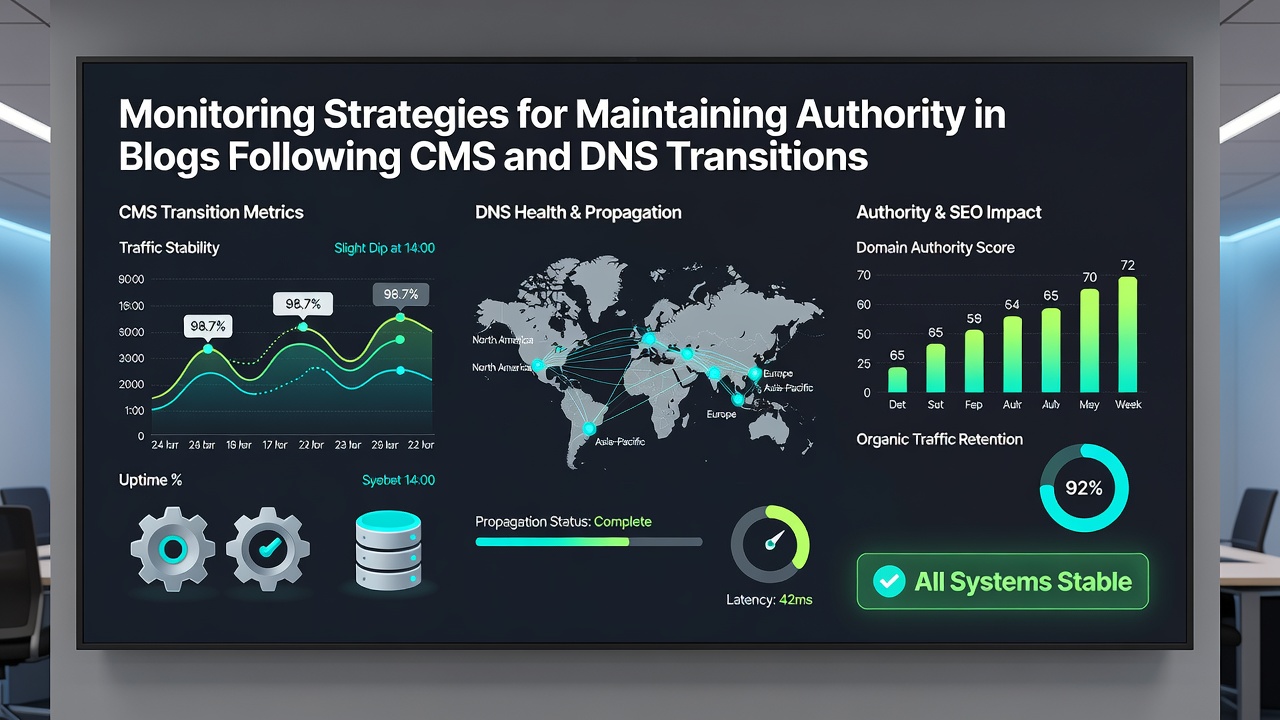
One study revealed that sites performing weekly content audits recovered indexed page counts faster than those conducting monthly reviews, particularly when the audits included checks for duplicate title tags and missing canonical links. Blog operators who integrate automated alerts for sudden drops in page speed scores maintain tighter control over user experience signals that influence authority calculations.
Key Metrics and External Data Sources
Effective monitoring programs focus on organic search rankings for target keywords, backlink acquisition velocity, and social referral trends, while also incorporating data from external platforms that aggregate industry statistics. ICANN documentation provides guidance on DNS stability that helps teams interpret resolution anomalies, and reports from academic centers such as Educause offer comparative benchmarks on digital platform transitions across educational institutions. These sources supply context that internal logs alone cannot deliver.
Figures reveal that blogs maintaining continuous uptime monitoring during the first thirty days post-transition experience fewer interruptions in crawler visits, which supports steadier authority preservation. Experts have observed that combining server-side logs with third-party SEO suites creates a more complete picture of how changes propagate through search algorithms.
Conclusion
Systematic monitoring after CMS and DNS transitions enables blog operators to detect and address authority fluctuations before they become entrenched, which supports faster restoration of search performance. By combining baseline records, propagation verification, migration audits, and cross-referenced external data, teams establish repeatable processes that protect long-term visibility. Continued application of these approaches yields measurable stability as sites settle into their new configurations.